
Local SEO Cardiff Guide: How to Win the Map Pack and AI Answers in 2026
By Caid Thomson / 26 November 2026 / SEO, Tips / 14 min read
What is local SEO in Cardiff?
Local SEO in Cardiff is all about getting in front of the customers looking for what you sell in and around the city: in the Google Maps pack, in the local search results and, increasingly, in AI-powered answers from Google’s AI Overviews, AI Mode and ChatGPT. It’s the local take on search engine optimisation (SEO), combining Google Business Profile optimisation, reviews, consistent listings, locally relevant website copy and local authority. This local SEO Cardiff guide explains how local search works, the strategy we use, what it costs and how to choose the right help for your business.
For a café in Pontcanna, a solicitor in the city centre or a roofer in the Vale of Glamorgan, local search is probably the most valuable way to win new customers. Searches like “accountant near me” or “best dentist in Roath” are clear in their intent: people want to find and use a service soon. Strong online visibility in those search results brings targeted traffic that general digital marketing just can’t match.
Why local SEO matters in 2026
Two changes have really upped the stakes for Cardiff businesses this year.
- Buyers check more before they choose. In BrightLocal’s 2026 survey, 97% of people read reviews for local businesses, and 41% always do, up from 29% a year earlier (BrightLocal).
- AI tools have become a discovery channel. Using ChatGPT and other AI tools to find local businesses has gone from 6% to 45% in a year, making AI the third most-used source after Google and Facebook (BrightLocal). That survey was in the US, but the same AI layer is now live in UK search too.
The businesses that succeed in Cardiff are the ones that show up consistently across all of these places, with the same details, strong recent reviews and a website that answers buyers’ questions clearly. Our guide to Search Everywhere Optimisation in Cardiff covers the wider picture beyond Google.
How local search works in Cardiff
Google ranks local businesses on relevance, distance and prominence. Relevance is how well your profile matches the search, distance is how far you are from the searcher or the place they’re looking for, and prominence is how well known and trusted you are, including your reviews, links and mentions across the web (Google Business Profile Help).
The three places Cardiff customers find you
- The map pack. The three businesses shown on a map for searches like “electrician Cardiff”. This is driven mainly by your Google Business Profile, how close you are to the searcher and what people say about you in reviews.
- Local organic results. The standard listings below the map, driven by your website: service pages, local content, links and technical SEO.
- AI answers. AI Overviews, AI Mode, ChatGPT and Gemini summarise and recommend businesses, using your website, reviews and third-party listings.
What local SEO experts think matters most
Whitespark’s 2026 Local Search Ranking Factors survey asked 47 local SEO specialists to score 187 factors (Whitespark). For the map pack, the top five were your primary Google Business Profile category, how close you are to the searcher, keywords in your business name, a physical address in the city being searched and whether you’re open at the time of the search. For local organic results, a dedicated page for each service and location-relevant content came out on top.
When it comes to showing up in AI search results, the weighting shifts noticeably:
| Signal group | Local organic results | AI search visibility |
|---|---|---|
| On-page (website content and structure) | 33% | 24% |
| Review signals | 6% | 16% |
| Citation signals (listings and mentions) | 7% | 13% |
| Google Business Profile signals | 7% | 12% |
Source: Whitespark 2026, as summarised by Advice Local and Digital Applied. For the map pack, Google Business Profile signals carry around 32% of the weight on their own.
So your Google Business Profile is what wins the map, but your website, reviews and listings are what get AI tools to recommend you.
What makes Cardiff different
- Distance is tight. A searcher in Llanishen and one in Grangetown might see completely different map packs for the same search. Businesses near the city centre often appear for “Cardiff” searches more easily than those in Cardiff Gate or St Mellons, so neighbourhood-level content and reviews that mention those areas matter.
- Service-area businesses span the region. Trades and home services often cover Penarth, Caerphilly, Barry, Pontypridd, the Vale and the wider South Wales area. Set realistic service areas and build pages for the places you genuinely serve.
- Bilingual search. Some customers search in Welsh, and public-sector and education buyers often expect Welsh-language content. Where it makes sense for your audience, a properly translated Welsh version, with hreflang, can open up a less competitive set of searches.
How to do local SEO in Cardiff the right way
The local SEO strategy that works in Cardiff has six parts: a fully optimised Google Business Profile, a steady flow of fresh reviews, consistent listings, strong service pages, local links and mentions, and content that AI tools can quote. Work through them in order; you’ll usually see the biggest improvements in map rankings from the first two.
1. Google Business Profile optimisation
Your Google Business Profile is free, and it’s the single biggest way to influence your map pack rankings.
- Primary category. Pick the most specific category that matches your main service. It’s the number one map pack factor in Whitespark’s survey.
- Services. Add Google’s predefined services as well as any custom ones, written the way your customers search for them.
- Accurate hours. Being open when customers search is now a top-five factor. Keep your hours and holiday hours correct, and never list hours you don’t actually keep.
- Map pin and address. Check that the pin sits on the correct entrance to your building. If you’re a service-area business, hide the address and set the areas you genuinely cover.
- Real photos and video. Pictures of your team, premises, vehicles and finished work look far better than generic stock images.
- Landing page. Link the profile to the page that best matches it, usually your homepage or a dedicated Cardiff page, and make sure the name, address and phone number match exactly.
- Bookings. Since November 2026, owners can manage their own appointments and reservation links in their profile, so check that yours goes to a booking page that works well on mobile (Search Engine Roundtable).
- Questions and answers. Google has been phasing out the public Q&A section on profiles, so answer common questions on your website and in your posts instead (Breeze Development).
Avoid stuffing the description and posts with keywords, and avoid AI-generated photos; both are flagged as negative or suspension-risk factors (Whitespark).
2. Fresh reviews
Reviews influence rankings, conversions and what AI tools recommend. Consumer expectations rose sharply in 2026 (BrightLocal):
| What consumers expect | 2026 figure |
|---|---|
| Only care about reviews left in the last three months | 74% |
| Won’t use a business with fewer than 20 reviews | 47% |
| Only use businesses rated 4.5 stars or higher | 31% (up from 17%) |
| Expect the business owner to respond | 89% |
| Put off by generic, templated replies | 50% |
Make reviews part of your process: a text or email after every job, a QR code on your invoices, and a personal reply to every review within a day or two. Spread reviews across Google and the platforms your industry uses, such as Trustpilot, Checkatrade or Facebook.
And keep it honest. Since April 2025, the Digital Markets, Competition and Consumers Act has made fake reviews and concealed incentivised reviews illegal in the UK, with fines of up to 10% of global turnover (CMS).
3. Consistent listings and citations
Your business name, address and phone number should be the same everywhere: Google, Bing Places, Apple Business Connect, Yell, Thomson Local, Facebook, Business Wales and the directories that matter in your industry. Inconsistent details confuse search engines and AI tools alike.
Citations matter more now than they have for years. Whitespark found that three of the top five AI search visibility factors are citation-related, including being featured on expert-curated “best of” lists (Whitespark).
4. On-page optimisation for local intent
Your website is the strongest signal for local organic results and AI search visibility. Start with keyword research to find the services, questions and place names your Cardiff customers search for, then build pages around them.
- Create a dedicated page for each core service, with Cardiff and your real service areas in the title tag, H1 and content.
- Only create area pages where you genuinely work and can say something specific. Thin pages that just swap one town name for another tend to backfire.
- Show your name, address and phone number in the footer, matching your Google Business Profile.
- Add LocalBusiness structured data, a reviews or testimonials page in the main navigation, and an FAQ section on each service page.
- Keep technical SEO in good order: fast site speed on mobile, HTTPS, clean internal linking and no duplicate pages.
5. Local link building and digital PR
Links and mentions from Cardiff and Welsh websites tell Google and AI tools that you’re a real, active part of the local economy. Good sources include:
- Local and regional press, such as WalesOnline and Business News Wales, through genuine stories and expert comment.
- Chambers of commerce, FSB Wales and trade associations.
- Sponsorships of local clubs, charities and community events.
- Partnerships with suppliers, universities and complementary businesses.
6. AI search optimisation for local businesses
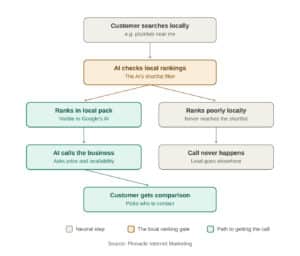
Answer engine optimisation and generative engine optimisation are the AI-era extension of traditional SEO. To be recommended by AI tools, give them clear, consistent facts to quote. Answer the questions customers ask on your service pages, such as prices, areas covered, response times and accreditations, in plain language. Keep your listings complete, earn reviews on the platforms AI tools cite in your sector, and pursue “best of” list inclusion. Our guide to AI search optimisation covers the full approach. In the US, Google is also testing AI that phones local businesses for customers, and our post on Google’s AI calling businesses explains why local pack rankings decide who gets that call.
Track what matters
Measure calls, direction requests and website clicks in your Business Profile performance report, organic traffic and enquiries in Google Analytics, queries in Google Search Console, and map rankings across a grid of Cardiff postcodes. Rankings viewed from a single office location can look a world apart from what customers in CF5 or CF23 see. Core updates can move local rankings too. Google’s November 2026 core update finished rolling out on 24 November, and Google has announced another for December, aimed at longer, more complex questions and personalised results. Wait at least a week after an update finishes, then compare that week with a week before it started (Search Engine Journal). From 17 December, UK competition rules also require Google to give site owners advance notice of significant ranking changes (PPC Land).
How much does local SEO cost in Cardiff?
Most Cardiff businesses should budget around £350 to £1,000 a month for proper local SEO, with established agencies starting at around £1,500 a month for competitive or multi-location campaigns. Packages under £300 a month exist, but they rarely include the content, links and strategy that bring real results. What SEO costs depends on what the services include, so compare scope as well as price. For reference, Pinnacle’s own local SEO packages run from £395 to £995 a month, depending on how many hours you need.
The most useful UK data comes from Whito’s 2026 study of 45 published SEO prices from 16 UK providers (Whito):
| SEO pricing band | Monthly cost | What you usually get |
|---|---|---|
| Budget | £99 to £300 | Basic profile upkeep and a few defined tasks, but little strategy |
| Mainstream business | £350 to £1,000 | The realistic minimum for proper local SEO: profile management, review generation, citations, on-page optimisation and some content |
| Established agency | £1,500 to £5,000+ | Strategy, content and link building, technical SEO, digital PR and reporting tied to business metrics |
The median published SEO retainer was £799 a month, and national SEO came out at 1.5 to 2 times the local price. Whito also found that most providers now include AI search visibility as standard rather than charging extra for it.
It’s also worth knowing that Whito puts the average freelance SEO day rate at £325, so a £300 package buys roughly one day of skilled work a month. That covers profile maintenance, but not much more. One-off work is priced separately: an SEO audit costs £500 to £3,000 on Whito’s figures. Free audits vary widely in depth, so check what one actually covers before you rely on it. Set an SEO budget you can sustain for at least six months; a short burst of SEO investment rarely shows its full return.
What drives the cost
- Competition. A dentist or solicitor in central Cardiff is up against far more competition than a specialist trade in a smaller town.
- Locations and services. Each extra location or core service usually needs its own page, profile work and reviews.
- Where you’re starting from. A site with technical problems, duplicate listings or no reviews needs some upfront work to fix.
- Content and links. Original content and genuine local links take the most time and skill, and they’re what really drive results.
Is local SEO worth it?
For most service businesses, yes. Unlike Google Ads, where clicks stop when your budget does, the work compounds over time and keeps earning enquiries. The best approach is often to use both, with paid search covering gaps while you build organic visibility over three to six months.
Common local SEO mistakes we see in Cardiff
- Chasing “Cardiff” only. People also search by neighbourhood and nearby town, so ignoring Penarth, Caerphilly or Barry leaves easy wins on the table.
- Duplicate or unverified profiles. Old addresses and duplicate listings confuse Google and split your reviews.
- Review bursts, then silence. Recency matters as much as volume. Keep a steady flow coming in rather than one big push.
- Thin location pages. Copying one page 50 times with a different town name doesn’t help anybody.
- Ignoring AI answers. If ChatGPT or AI Overviews recommend competitors for your services, you’re losing enquiries you’ll never see in your analytics.
How to choose a local SEO agency in Cardiff
Whether you’re comparing an SEO agency in Cardiff, a freelancer or an in-house hire, ask these questions before you sign:
- Which Cardiff or South Wales clients have you worked with, and can we talk to them?
- What exactly will you do each month, and how many hours does the fee cover?
- Will you report results in enquiries and calls, or just rankings?
- How do you build links and reviews, and do your methods comply with Google’s guidelines and UK law?
- How do you measure and improve our AI search visibility?
- What’s the notice period?
Be wary of any agency promising guaranteed first-page rankings, or offering packages that seem suspiciously cheap. No agency controls Google, and low-quality SEO can cost more to sort out than it did to buy.
Frequently asked questions
Is a Google Business Profile free?
Yes. Creating, verifying and managing a Google Business Profile costs nothing. You only pay for the time, or the agency, spent optimising it and keeping it active.
How long does local SEO take to work in Cardiff?
Profile fixes and a steady flow of new reviews can lift map rankings within a few weeks. Gains from new service pages, citations and local links usually take three to six months, and longer in competitive city-centre sectors such as legal, dental and trades.
Can I do local SEO myself?
Yes, for the basics. Any business owner can set up and manage their Google Business Profile, ask customers for reviews and keep their listings consistent. Content, link building, technical SEO and AI search visibility take more skill and time, which is where an agency earns its fee.
What is the difference between local SEO and national SEO?
Local SEO targets people searching in a specific area, through the map pack, local search results and location-aware AI answers. National SEO targets searches with no location, where you’re up against businesses across the UK, so it usually costs 1.5 to 2 times as much.
Does local SEO help with AI search?
Yes. The same signals that drive local rankings, especially your website content, reviews and consistent listings, are what AI tools use to decide which local businesses to recommend.
Talk to a Cardiff SEO expert
Pinnacle Internet Marketing has been based on Pantbach Road, Cardiff, since 2006, helping local businesses grow through search. We combine local SEO, Google Ads and AI search optimisation into one plan built around real enquiries, not vanity rankings. Want to know how your business shows up in the map pack and in AI answers today? Speak to our Cardiff SEO team.