
Google Just Confirmed What We’ve Been Figuring Out All Along
By pinnacleadmin / 8 June 2026 / Digital Marketing, GEO, SEO / 14 min read
The industry’s been inventing new acronyms left & right – AEO, GEO, LLMO and AI SEO – but Google’s own messaging essentially boils down to:
“This is still SEO.”
And in many ways, they’re spot on. I have to admit, I’m a bit tired of all the different terminology and wanted to do my own digging into what it all really means – as my gut has been telling me it’s all the same, isn’t it? Yeah.
AEO and GEO Aren’t Replacing Old-School SEO — They’re Exposing What Good Search Engine Optimisation Was Always Supposed To Do
The biggest misconception in the industry right now is that AI search requires a whole new marketing discipline.
But the reality is:
- AI systems just want clear and simple answers
- Search engines still reward authority and trustworthiness
- And users still reward usefulness and solutions to their problems
That’s the Search Engine Optimisation we know and love. For all you SEO newbies out there, that same foundation still matters. The only difference now is that:
- Weak content gets weeded out much faster,
- Bad technical foundations are visible for all to see,
- And formatting is way more important than keyword stuffing ever was
I’ve been doing Search Engine Optimisation for 15 years now, and the truth is my core strategy hasn’t fundamentally changed. Of course, the mechanics have evolved, and the delivery has changed, but the principles are still remarkably consistent.
Google itself said the following: “From Google Search’s perspective, optimising for generative AI search is optimising for the search experience, and thus still SEO.” In practice, answer engine optimisation is just an extra extension of core SEO – not a separate discipline at all. Reading official best practices and guides from search engines like Google’s own documentation helps improve SEO knowledge, too.
Content Is Still King, But Structure Is Now The One in Charge
Clever heading, I reckon.
These AI search systems don’t “read” content like a human would. They rely on signals like structured data. They extract, they summarise, they retrieve, they compare.
Which means:
- A clear hierarchy in your content matters a lot
- A concise answer to a given question matters
- Semantic structure is key
- Schema matters a lot
- Entity relationships matter
- Topical completeness is still a must
You should be creating helpful, intent-driven content that directly answers user questions and solves their problems.
It’s pretty amazing, although – I’m still fighting off AI hallucinations and results that are pure nonsense.
The days of churning out long-form content and just trying to stuff as much information into it are long gone. Content quality and structure matter way more than the length of the article alone. Writing with frequently searched keyword phrases can increase traffic by making pages align with a wider range of search queries. A 3,000-word article with no structure now gets beaten by a little article with:
- Properly segmented headings
- FAQ blocks
- Definitions
- Comparisons
- Stats
- Concise answer paragraphs
- And clean semantic markup.
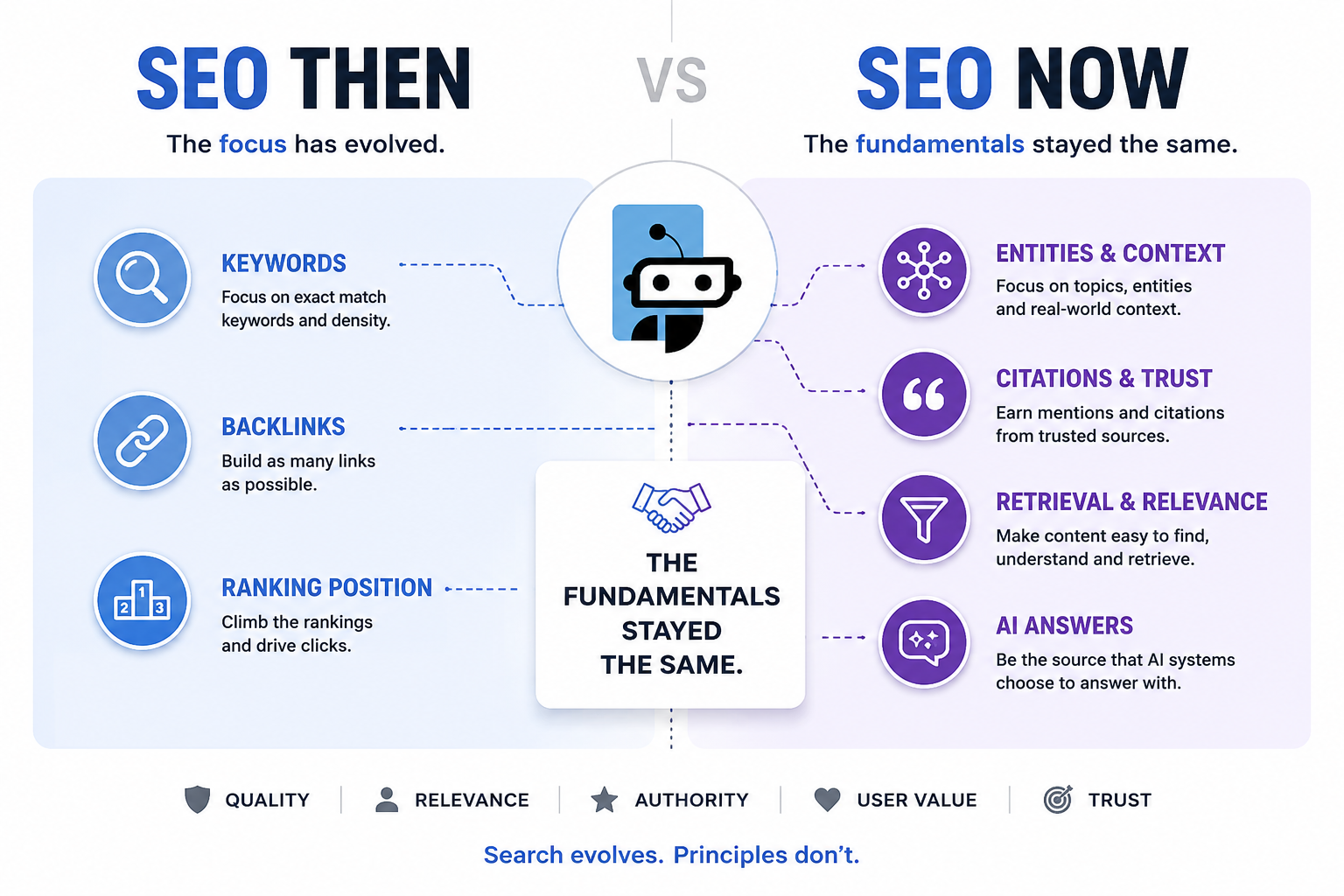
| Old SEO Thinking | AI Search Reality |
|---|---|
| Longer content = better | Better-structured content = better |
| Keywords = everything | Entities & context = everything |
| Ranking = the number one goal | Citation and retrieval are now the goals |
| Optimise pages | Optimise information architecture |
What’s Changed About Keyword Research?
Honestly, I think this part of my SEO journey has changed the most. Keyword research still remains an important part of search engine optimisation, but the way we approach it has evolved to identify target keywords and relevant keywords way more precisely.
Today, keyword research does more than just identifying popular search terms; it involves understanding the intent behind user queries and mapping out conversational search phrases that reflect how people naturally ask questions, including how users search and how search behaviour is shifting in conversational environments. This means SEO pros have to analyse a wider variety of search terms, including long-tail keywords and natural language queries, to get a full scope of relevant user intent.
Also, modern keyword research incorporates data from multiple sources, such as:
- Google Search Console
- Google Analytics
- SEO tools
To gain insights into how users discover and interact with content. These tools help identify:
- Which keywords drive organic search traffic
- which queries lead to conversions
- where opportunities exist to improve search engine rankings.
This also reveals which queries bring High-Intent Traffic from people looking for immediate solutions or purchasing opportunities.
By incorporating semantic keywords and related entities into content, you enhance topical relevance, which helps search engines understand and rank pages appropriately.
Moreover, keyword research now involves anticipating prompt-style search behaviour, where users refine or expand their queries with follow-up questions. You essentially have to become a chatbot. By incorporating responses to these potential queries within your content, websites can boost their likelihood of being featured in AI-generated answers and voice search results.
The New Game In Keyword Research: All About Content That Spices Up Your Digital Presence
Ultimately, doing keyword research the right way these days is about creating valuable content that speaks to how search engines like Google are now going about discovering, figuring out and ranking relevant pages. It’s key to keeping your website visible and an authority in an ever-more competitive landscape. And it’s also about supporting a broader seo strategy that ties into actual business results like sales, leads, and actually making a profit, not just about getting your site to rank well.
Has Technical SEO Gone From Being Underestimated to Becoming Absolutely Crucial?
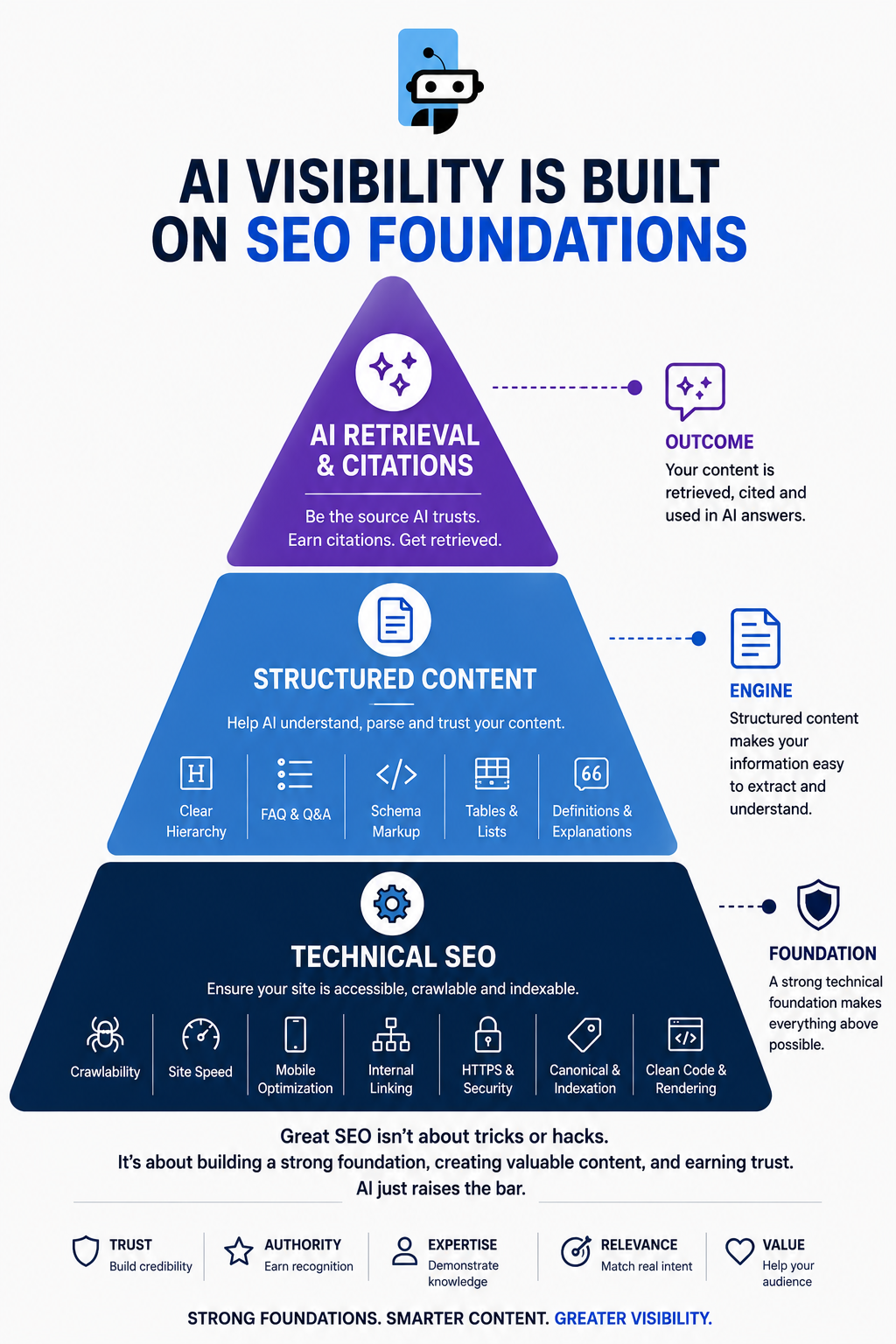
Personally, my favourite part of seo and the part most businesses still have no idea about. The thing is, AI-powered crawlers and retrieval systems are totally reliant on the technical optimisation and underlying tech that makes a site visible in the first place:
- Getting the crawl efficiency right,
- Making sure your internal linking is clean and easy to follow,
- Using schema effectively,
- Ensuring your site is accessible and loads ok for search bots,
- Optimising page speed,
- Getting the canonical version right,
- Checking your site’s indexation health,
- And having all your pages linked up properly.
It’s worth pointing out that this is just how search engines work – search engines discover sites using bots and crawlers, through internal and external links, then get to work crawling the site and indexing its pages so that they can surface for queries. But then there are the algorithms that decide what gets ranked where.
The irony of all this is that for years, many businesses have thrown technical seo under the bus and put all their effort into just publishing more content. But now that we’ve got AI systems that can instantly spot any weak foundations, that just isn’t good enough any more. Search engines love it when you use secure HTTPS, abide by mobile friendliness and make it easy for bots to get to, particularly since mobile-first indexing now uses the mobile version for indexing and ranking.
Good technical seo now has a big impact on:
- Whether your content gets retrieved,
- Whether your entities get understood,
- Whether your answers get trusted,
- And whether AI systems can confidently cite you as an authority.
Technical seo issues like poor crawl depth, having multiple URLs without proper canonicalisation, or weak linking can also just stop your pages from being found, stored and ranked.
AI Search Rewards Brands That Get How Expertise Really Works
This is where EEAT comes in without sounding like a broken record.
Google’s AI systems and LLMs are getting more and more interested in content that really shows clear expertise, authority and trustworthiness. As you’d expect, this means websites should focus on providing unique insights that go further than just regurgitating obvious facts, and offering fresh perspectives that users can’t find elsewhere. First-party data is highly valued in all this, as it reflects authentic, proprietary information that adds credibility and depth to your content.
On Page SEO
Commentary from industry experts or genuine subject matter experts adds loads to the perceived authority of a website. Including well-researched stats and up-to-date case studies helps strengthen the content by backing up claims with actual evidence, while title tag optimisation and clear on-page signals help search engines make sense of what your content is all about. And authoritative citations that reference reputable sources, and link to well-recognised orgs or publications, help verify the accuracy and trustworthiness of your information.
An example of all this is:
Google AI Overviews now pop up in about 20-30% of all searches, with much higher visibility on info and question-based queries, which just reinforces the stronger seo results and seo success overall.
The Data To Back It Up:
- Google AI Overviews appear in 20.5% of all keywords according to Ahrefs.
- On problem-solving searches, AI Overviews appeared in 74% of queries.
- Question-form searches trigger AI Overviews at rates of 65%.
By consistently using all this stuff, websites can keep in line with Google’s evolving AI-driven algorithms, which are all about valuable, solid content. This approach doesn’t just help with traditional search results rankings – it also increases your chances of being featured or cited in AI-generated answers and summaries, which just boosts your overall visibility and credibility.
In short, this is the same stuff good SEOs have been saying for years. I reckon AI search is just filtering out all the low-quality stuff, so:
- Generic affiliate content
- Low-value rewritten blogs
- Mass-produced SEO filler
That’s not a new discipline. That’s just a quality filter.
Is GEO/AEO Just A Repackaging Of Mature SEO Principles?
What’s Actually New:
Google Searches
AI answer interfaces represent a major shift in how search engines deliver info as search behaviour changes, and people are increasingly looking for answers through conversational style interactions. Instead of just presenting a list of traditional search results, these interfaces provide direct answers extracted from multiple sources, so users can get the info they need quickly.
This changes the way content creators need to approach SEO, with a focus on simplicity and clarity so that your content gets selected as a reliable answer.
Conversational query mapping reflects the rise of natural language processing in search engines. Users now interact with search systems through more conversational, complex queries rather than simple keyword phrases.
SEO strategies need to adapt by understanding and targeting these conversational queries, linking this shift in optimisation back to wider SEO practice and making sure your content is aligned with how users naturally ask questions.
Multi-modal retrieval refers to AI search’s ability to extract and process information from multiple content types like images, text, videos and audio. This broadens the scope of SEO to cover a whole lot more than just text optimisation – because search engines are now looking at a lot more than just words. Image SEO and video SEO become way more important because search engines are now looking at more than just text.
Prompt-style search behaviour highlights how users interact with AI-driven search tools – it’s that thing where you give the AI a prompt or a follow-up question to help refine your search.
SEO pros need to be able to anticipate these kinds of search behaviours and create content that actually addresses the follow-up questions people are likely to ask, so that they can increase their chances of appearing in those dynamic search interactions.
Entity reinforcement involves making it crystal clear what entities are and how they’re related to each other – people, places, concepts and so on – within your content. And why this is important is that the AI systems use these entity relationships to get a better handle on the context and relevance, so it’s essential for SEO to focus on getting those entity relationships right, to make your content easier to find.
This shift means you need to keep an eye on your SEO performance across all sorts of metrics – visibility, organic traffic, engagement and outcomes.
Off-Page SEO and External Links
Citation optimisation is all about improving search visibility by building up your brand authority and external trust signals – by doing stuff outside of your website.
- Backlinks remain super important because they tell search engines that other websites actually think your content is worth linking to, which can improve your authority and your ranking.\
- And off-page efforts that are effective can also include social media marketing and managing online reviews to build up your brand reputation and authority.
As AI-generated responses often reference their sources, optimising for citation means making sure your content and data is structured in a way that helps the AI actually recognise and trust you as a credible authority – so that your brand gets more visibility in those AI-driven search experiences.
What isn’t new:
Topical authority is still super important in SEO, even as AI search changes the interface. You still need to demonstrate deep expertise and comprehensive coverage of a subject area, and that’s still going to get you ranked well with search engines.
Structured content is still vital for both users and search engines. Well-structured content with clear headings and a logical progression, and semantic markup to help the search engines understand the hierarchy and significance of the information, is still going to get you indexed pages and ranked more effectively.
Crawlability is a fundamental technical SEO aspect that makes sure search engine bots can easily discover and navigate your web pages. And that means keeping your site structure clean, avoiding broken links, and optimising your internal linking – all the usual stuff.
Relevance is still about making sure your content aligns with what the user is actually searching for – it’s about answering the questions they’re asking and providing value that matches their expectations, so that you can rank well in search engine results pages.
Information gain is still about the value your page adds beyond what’s already out there online – it’s about having unique insights and original data and comprehensive analysis to signal to search engines that your page is a meaningful contribution to the topic.
Semantic relationships are about understanding and leveraging the connections between concepts and entities within your content. This makes it easier for search engines to interpret context and improves the chances of your content appearing for a broader range of related queries.
User search intent optimisation is still all about creating content that satisfies the underlying purpose behind a search query – whether it’s informational, navigational, transactional or commercial investigation, so that users can find exactly what they need.
What I’m really trying to say is that terminology changed faster than the strategy.
So, What Does This All Mean For Organic Search?
Despite all the changes in AI-driven search technologies and the emergence of new concepts like Answer Engine Optimisation (AEO) and Generative Engine Optimisation (GEO), the core principles of organic search are still fundamentally the same.
At its heart, organic search is still all about delivering relevant, authoritative and user-friendly content that meets the needs and intent of internet users. So businesses and marketers should still be focusing on creating high-quality content and optimising technical SEO aspects and building up a credible online presence – because the bottom line is that SEO is still super important for increasing visibility, improving user experience and supporting sustainable growth.
Websites that invest in strong technical foundations and comprehensive content strategies are in a better position to benefit from both traditional organic search and AI-powered results. And the good news is that organic traffic is cost-efficient because it doesn’t require ongoing payment like paid advertising – the first position on Google can capture roughly 40% to 60% of all organic traffic.
In Conclusion:
Around 20% of Google searches display AI Overviews, and over 65% of searches finish without any clicks. At the same time, ChatGPT is serving hundreds of millions of weekly users, and the SEO industry is evolving quickly as AI changes how people discover information.
The search landscape is changing – but the brands that are succeeding in AI visibility are still the ones with strong technical SEO, authoritative content and structured information architecture.
The future of SEO may look different in the interface, but underneath the AI layer, the same fundamentals still decide who gets discovered, who gets trusted and who gets cited.
AEO and GEO may be the industry’s newest buzzwords, but the brands that are winning in AI search are usually the ones that mastered SEO long before the acronyms changed.