AI Search: The Complete Guide to Navigating Artificial Intelligence Search Engines in 2026
By pinnacleadmin / 29 July 2026 / GEO, Google, SEO / 15 min read
Introduction
AI Search has entered the scene as a game-changer in how people find information online.
AI search engines use artificial intelligence to understand the context, intent, and conversational meaning behind queries. Instead of just listing links, they deliver direct, synthesised answers—often without showing links at all.
This shift is transforming how people discover information, evaluate products, and make purchasing decisions. If your business depends on online visibility, you must pay attention now.
This guide covers:
- What AI search is and how it differs from traditional search
- The impact and opportunities AI search creates for businesses
- Practical AI search optimisation techniques
- How to monitor your performance in AI-driven search
- Preparing your business for AI-generated search results
Written for business owners, marketers, and content creators, this guide explains AI-driven search clearly without complex AI jargon.
Bottom line: AI search uses large language models and natural language processing to understand what users want and provide direct, detailed answers from across the web. Your content either gets cited in these answers or gets left behind.
What Are The AI Search Fundamentals?
AI search represents the biggest change in how people find stuff since Google replaced phone books and library catalogues. Rather than matching keywords to indexed pages, AI systems get what’s going on in a query, keep the conversation going, and generate answers from all sorts of places, from big databases to real-time web sources.
What Is The Difference Between Traditional Search and AI Search?
Traditional search engines rely on keywords to figure out what to show you. You type a query, the engine looks for words in its index, and spits out a list of links for you to click through. You then have to rifle through multiple pages to piece together an answer.
Ah, the good old days.
AI search engines are different. They use advanced algorithms to understand the context and intent behind your query. Instead of showing ten blue links, AI models provide direct answers.
They recognise that someone searching for “best way to keep my team organised” and “best project management tool” likely want the same thing, even if the keywords differ. AI-driven search focuses on meaning, not just matching words.
This shift reflects changing search behaviour:
- Nearly 60% of mobile Google searches end without a click.
- Users want quick, detailed answers without browsing multiple pages.
- AI search maintains conversational context, allowing follow-up questions.
The era of clicking through multiple results is fading as AI delivers concise answers instantly.
What Are The Core AI Search Technologies?
Several technologies drive this revolution—understanding them explains why some content gets cited and others don’t.
Large language models (LLMs) like OpenAI’s GPT series, Google Gemini, and Anthropic’s Claude are trained on massive text data to generate human-quality responses. These AI models generate answers by weaving knowledge into coherent, contextual replies. Natural language processing helps AI understand user intent like a human.
Retrieval-Augmented Generation (RAG) combines user queries with relevant information from the web, databases, or knowledge bases, ensuring up-to-date, accurate answers. AI search integrates real-time web crawling, so freshness matters.
Other key technologies include:
- Semantic search and vector embeddings: Convert content into mathematical meaning representations, enabling AI to match queries like “durable outdoor promotional items” with “weatherproof branded umbrellas” even without shared keywords.
- Multimodal capabilities: Allow AI to process text and images, so relevant images, diagrams, and product photos increasingly appear in AI-generated responses.
Together, these technologies create a search landscape where content quality, structure, and authority matter far more than keyword stuffing.
Why Does AI Search Matter for Your Business?
The technologies driving this change aren’t theoretical – they’re reshaping search for millions of people every day. And the business implications are huge – and pressing.
How is AI Changing User Search Behaviour?
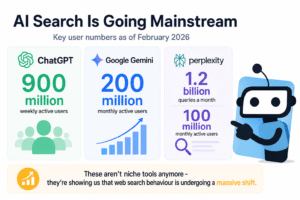 Most of your mobile Google searches now end without a click, right? Users increasingly expect quick answers and detailed answers that just appear, without having to click through ten pages. AI search makes it all just show up in seconds – and maintains the conversation as it goes along.
ChatGPT had an astonishing 900 million weekly active users by February 2026. Meanwhile, Google Gemini had knocked up over 200 million monthly active users. Perplexity was handling an incredible 1.2 billion queries a month and had a whopping 100 million monthly active users. These aren’t niche tools anymore – they’re showing us that web search behaviour is undergoing a massive shift.
Google’s AI Overviews are now cropping up in around a quarter of all Google search results, and in some cases, they are even causing click-through rates to drop by as much as 38% to websites. 60% of mobile Google searches are now ending without a click. A chock-a-block 30% of ChatGPT prompts are actually turning up in the traditional search intent categories, which means a load of people are using AI tools as a replacement for Google in their everyday research.
AI search is expected to eventually blow traditional search out of the water – and we’re talking just 18 months from now. This isn’t some far-off prediction; it’s pretty much already happening.
Business Impact and Opportunities
For businesses, AI search brings both significant risk and opportunity.
The risk is clear: 90% of businesses worry about losing visibility due to AI. Without well-structured, authoritative, and properly referenced content, AI platforms will cite competitors instead. Google’s AI overviews often summarise answers without linking to your site, making optimised landing pages invisible.
However, the opportunity is equally dramatic:
- AI referrals to leading websites rose by 357% in June 2025.
- AI search optimisation can increase brand visibility by 357%.
- Being cited in AI-generated answers acts as a permanent endorsement, putting your brand in front of millions.
- Personalisation allows AI systems to tailor responses to user intent.
- AI search supports e-commerce by analysing shopping behaviour and providing tailored recommendations.
- It also aids business intelligence by visualising structured and unstructured data.
Embracing AI search strategically can transform risks into competitive advantages.
Competitive Advantage Through Early Adoption
The businesses that start optimising for AI search now will gain serious compound advantages. Building topical authority, getting cited across AI platforms, and establishing structured data foundations takes time. Early adopters will accumulate valuable signals long before competitors catch up.
Waiting is the riskiest strategy. AI platforms are rapidly diversifying—ChatGPT’s referral share has dropped from 84% to 76.8% as Google Gemini, Perplexity, and others grow. AI search tools also automate customer support by answering queries, disrupting service-focused businesses.
Key reasons to act now:
- Build topical authority and semantic linking
- Gain citations in generative AI responses
- Establish structured data and schema markup
- Adapt to shifting user behaviour and AI features
- Leverage real-time answers and up-to-date information
The question isn’t whether to optimise for AI search, but whether you’ll lead or follow. That’s where Pinnacle Internet Marketing’s strategic guidance makes all the difference for businesses navigating this transition.
AI Search Platforms and Optimisation Strategies
Getting your head around which AI search platforms matter and how to optimise for them requires both platform-specific knowledge and some universal content principles. Here’s the practical lowdown.
Leading AI Search Platforms
Each of the major AI platforms has its own unique characteristics which will affect how your content shows up in AI search results:
- ChatGPT (OpenAI) – The big cheese with ~900 million weekly active users and 55-65% market share. Favours well-structured, authoritative and high-quality content. Tends to prefer trusted sources and detailed guides. AI search engines are pretty good at handling complex, conversational queries on this platform, so comprehensive content is a must.
- Google AI Overviews / AI Mode – Integrated directly into Google Search, and reaches billions of users. Google’s AI overviews pull from pages that are already ranking well in traditional search, so a solid SEO strategy remains the foundation. The search generative experience rewards content that has robust E-E-A-T signals and structured data.
- Perplexity – Has over 100 million monthly active users and the fastest growth rate among the major platforms. Transparent citation model that references multiple sources. Has a strong recency bias – recent, accurate content that clearly references sources performs well. Ideal for businesses that publish fresh industry analysis and how-to content.
- Bing AI / Microsoft Copilot – Integrated into Microsoft’s suite of tools including Edge, Windows and Office. Smaller share but significant in enterprise and professional contexts. Bing AI draws from Bing’s search index, so optimisation for Bing’s crawlers is a good idea.
- Claude (Anthropic) – Has a growing presence, especially in enterprise and professional use cases. Prioritises accuracy, safety and verifiable claims. Content that highlights certifications, verified data and transparent sourcing performs well.AI search engines give priority to content that’s citation-worthy when deciding what to show users across a range of platforms. The key is that generative AI tools tend to prefer content that is simple to read, written in a way that comes across as an authority, structured nicely, and actually useful.
Content Optimisation for Visibility in AI Search
The shift away from traditional SEO and towards AI-based search optimisation requires a rethink in multiple areas. Let’s see how the different approaches compare.
| Factor | Traditional SEO | AI Search Optimisation |
| Content Layout | Where keywords get placed, meta tags, header tags and the rest of it | Semantic headers that make sense, FAQ sections, and clear answers to the questions people are asking |
| Authority Signs | Backlinks, Domain Authority, Google rankings and all that | References to your work in AI results, mentions in the media, and E-E-A-T signals |
| Tech Specs | Page load speed, being mobile-friendly, and making sure search engines can crawl it | Schema markup, structured data, and making sure your content is in a format that AI systems can read |
| Success Metrics | Google rankings, organic traffic, and click-through rates | AI visibility, the number of times your content is cited, and referral traffic coming from AI platforms |
| Content Focus | Writing for the keywords | Creating content clusters around questions and answers that help AI search engines understand what it’s all about |
| Content Refresh | Changing things up every now and then | Regularly refreshing your content is a big signal to AI systems of who you are and what you know |
Instead of having to choose between traditional SEO and optimising for AI systems, smart businesses do both – your Google rankings are good for your Google AI profile too, and by putting in the effort to make your brand visible in other AI platforms like ChatGPT, Perplexity, etc you make sure you get in front of all of the right people.
The upshot is: if you’re currently doing content marketing that just focuses on writing about the keywords, you need to broaden out and start writing more in-depth, question-answering content that shows people you’re an expert in your field. The answers are not just about hiding keywords anymore, but being genuinely informative to the people searching.
Implementing Tech and Schema
When it comes to search engine optimisation for AI, we need to think a bit beyond just making sure it’s crawlable. We still need to make sure it loads quickly and is mobile-friendly, but now we also need to think about how we structure the data on our website.
Structured Data
Structured data is essential. It’s the best way to get your website in a format that AI systems can read, and help them get your product details, FAQs, authorship information, and other details. By using schema.org markup, we can turn your human-readable content into a format that AI models will trust. This means your website gets a good reputation with the AI systems, which makes them more likely to reference it in search results.
E-E-A-T Optimisation
E-E-A-T stands for Experience, Expertise, Authoritativeness, and Trustworthiness. This is really important for AI if you want your content to be cited by AI results. It’s the barometer for how reputable you are. To boost E-E-A-T, make sure to author pages with your credentials, cite your sources, and get real-world experience in the area you’re writing about.
Semantic linking and Topical Authority
By creating clusters of content around related topics and linking them together properly, you show AI systems that you’re a knowledgeable source on these topics. This is called semantic linking and topical authority, and it’s essential to making your brand visible in AI search results. You can make this easier to understand by using schema markup to help search engines and AI systems see the relationships between your content.
Digital PR and Earned Media
Getting your brand mentioned in the media is a great way to get your content referenced by AI. Research shows that around 80-90% of citations come from earned media, not brand-controlled content. So building relationships with industry publications, writing for them, and getting editorial coverage is a great way to get noticed in AI results.
Common Challenges and Solutions
When it comes to implementing an AI search strategy, there are new challenges that many businesses are unprepared for. Here are the common problems and how to fix them.
Falling Organic Traffic
As AI-generated summaries start answering questions directly, organic traffic can take a hit. But instead of fighting it, you need to make sure your brand is visible in AI search results instead. Create content that gets cited in AI-generated responses, maintain traditional SEO, and invest in content that gets referenced by AI. This can actually boost your visibility and brand reputation in AI results.
Lack of AI Search Expertise
Most marketing teams are trained in traditional SEO, not AI search optimisation. But understanding how AI systems select sources and how to structure content for them is a different skill. This is where working with a specialist can make a big difference. By partnering with an experienced agency, you can get the expertise you need to start ranking in AI search results, and see real results.
Measuring the Performance of AI Search
Standard analytics can’t keep up with AI’s impact on visibility. Often, AI answers appear without generating clicks, so traditional referral traffic metrics fall short. AI systems prioritise content that’s clear, credible, and well-structured, but proving your content is referenced requires new tools and methods.
To address this, switch to AI-specific monitoring tools such as Ahrefs’ Brand Radar AI, which tracks your brand’s presence on AI-powered platforms. Use UTM parameters on links generating referral traffic from AI engines. Monitor citation share—the percentage of AI responses referencing your content—and track question-triggered searches to identify which conversational queries lead to citations.
Key monitoring actions include:
- Using AI visibility tracking tools to measure brand appearances on platforms like ChatGPT, Google Gemini, and Perplexity
- Implementing UTM parameters for referral traffic analysis from AI sources
- Monitoring citation share to evaluate how often AI responses reference your content
- Analysing conversational queries and follow-up questions driving citations
- Building dashboards that integrate AI visibility with traditional Google rankings for a comprehensive performance overview
Conclusion and Next Steps
What we’re seeing here is nothing short of a fundamental shift in how consumers find and use information – not just some minor tweak to the algorithms, but a whole new way of doing things. By early 2028, AI search is projected to overtake traditional search, and the businesses that get ahead of the curve are going to be the ones who come out on top in terms of visibility, authority and revenue. Those that take too long to adapt are going to find themselves invisible in the AI-generated responses that are increasingly driving the way consumers and B2B buyers make decisions.
Here are the things you need to do right now:
- Audit your existing content to see if it’s AI-ready – take a close look at whether your pages give clear answers to specific questions, if they use structured data, demonstrate E-E-A-T, and offer the kind of authoritative details that AI search engines actually cite.
- Implement structured data and schema markup across all your key pages – think products, FAQs, how-to guides and organisational information.
- Keep an eye on your AI search mentions using special tools that track whether your brand shows up in ChatGPT, Google Gemini, Perplexity, and other AI-powered platforms.
- Develop a content authority strategy that builds on interconnected content clusters around your core areas of expertise, targeting the real conversational queries that your audience actually asks.
- Partner with people who know what they’re doing in this space. Companies like Pinnacle Internet Marketing can help you out with comprehensive AI search optimisation services – from the technical stuff to content strategy to ongoing performance tracking. That way, you can stay ahead of the curve and become a real leader in the AI search space instead of just playing catch-up.
As the AI landscape keeps on evolving – and it’s moving fast, with voice search, multimodal search and generative AI tools all expanding rapidly – what you put in place now is going to determine your visibility for years to come. There are plenty of other topics worth exploring too, such as optimising for voice search, doing local SEO for AI-driven search, and the emerging ad models that are cropping up in AI platforms.
Additional Resources
- Schema.org – your comprehensive resource for structured data vocabulary and implementation guides, to make your content machine-readable
- Google’s Search Quality Evaluator Guidelines – a must-read for anyone who wants to understand the E-E-A-T principles that influence both traditional and AI search visibility
- Semrush’s AI Search Optimisation Guide – a bunch of practical tips for optimising content across generative AI platforms
- Pinnacle Internet Marketing – get in touch with us to get a comprehensive AI search audit, strategy development and implementation support tailored to your business. We help businesses navigate the full gamut of AI search optimisation, from technical SEO to content marketing to performance tracking.