
Google’s AI Can Now Call Businesses On Your Customers’ Behalf — Is Your Local SEO Ready?
By pinnacleadmin / 26 August 2026 / GEO / 9 min read
For twenty years, winning at local search meant one thing: getting found. A customer searched, saw your business, and picked up the phone themselves. That chain has just gained a new link — and it’s one most businesses haven’t prepared for.
Google has rolled out an AI-powered calling feature that phones local businesses directly on a customer’s behalf, asking about pricing, availability and service details before handing the customer a side-by-side comparison. No form. No chat. An actual phone call, made by an AI, to your business — and it only calls the businesses it can already see ranking well.
This article explains what the feature does, where it currently stands, and — most importantly — what businesses need to do now to make sure they’re one of the businesses that gets the call.
What Is Google’s AI Calling Feature?
Google first tested this under the name “Ask for Me” in early 2025, initially limited to nail salons and auto repair shops. Since then it has expanded steadily:
- Mid-2025: rolled out to all Search users in the US, moving beyond the initial test categories
- 2026: extended into the much larger home-services market, including trades such as roofers, plumbers, electricians and cleaners
- I/O 2026: Google announced agentic booking within AI Mode, extending the feature into home repair, beauty and pet care, with the AI able to place calls itself and return a written comparison of what each business said
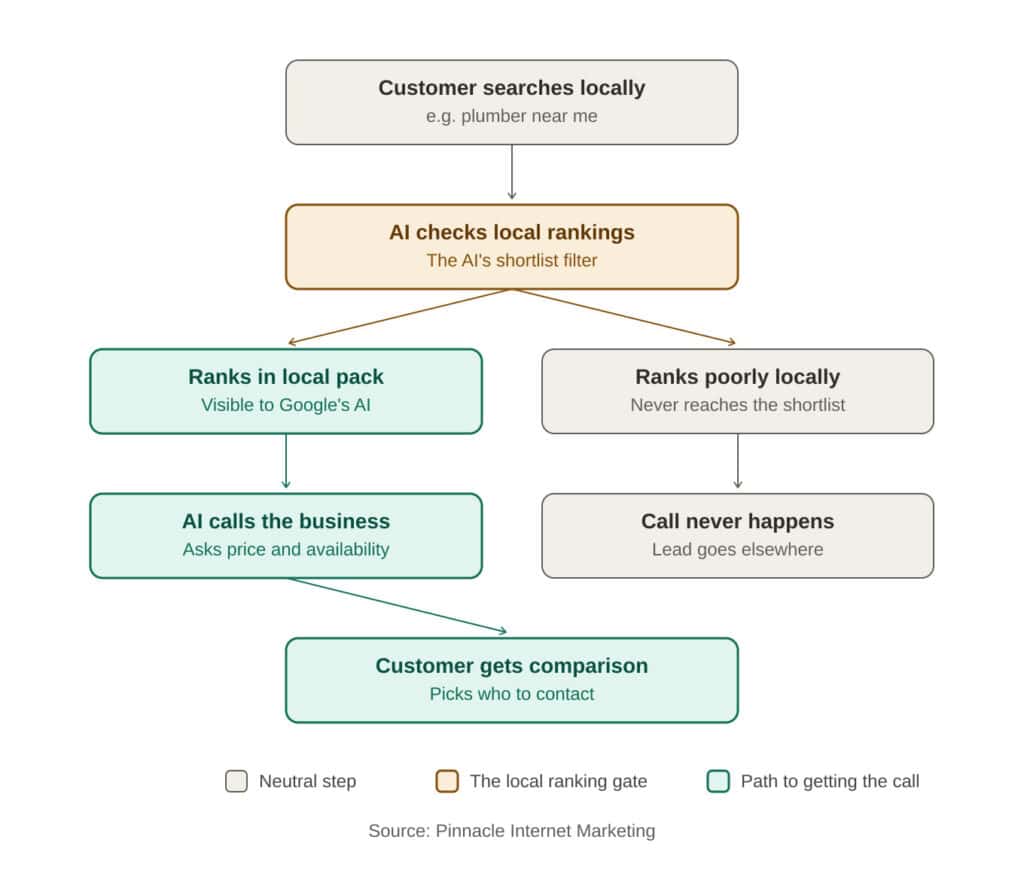
The mechanics are consistent throughout: a customer searches for a local service, and instead of scrolling through listings, they can ask Google’s AI to check pricing and availability for them. The AI then calls a shortlist of relevant local businesses, asks the questions the customer needs answered, and sends back a summary — comparing your business directly against your competitors.
How Does It Actually Work?
A few details matter here, because they shape what businesses need to do about it:
- The AI identifies itself. It calls as an automated system acting on behalf of a customer, and the calls are monitored and recorded rather than disguised as a normal enquiry.
- It only calls businesses that are already visible. The AI selects who to contact using standard local search rankings — in practice, this typically means it is pulling from the businesses already appearing near the top of the local map pack for that specific search.
- Businesses can opt out. Google gives businesses control over participation via their Business Profile settings, along with caps on how often a business can be contacted.
- The output is comparative. The customer doesn’t just get one answer — they get a written comparison of what every business said, side by side.
That last point is the one worth sitting with. A business that gives a vague or slow answer isn’t just missing an opportunity — it’s actively losing to a competitor’s answer in a document the customer is looking at right now.
Is This Coming To The UK?
At the time of writing, this feature is live across the United States only. Google has indicated more agentic AI features will roll out to subscribers before expanding internationally, and Canadian availability has been flagged for consideration, but there is no confirmed UK launch date.
That said, Google has a consistent pattern of testing consumer-facing AI features in the US first and expanding to other English-speaking markets once the mechanics are proven. Given how quickly this feature has moved — from a narrow Search Labs test in January 2025 to full agentic booking within eighteen months — UK businesses would be wise to treat this as a “when,” not an “if,” and prepare accordingly rather than waiting for an announcement.
Why Local SEO Rankings Determine Who Gets Called
This is the part that should focus minds. The AI isn’t calling every business it can find — it’s calling the businesses that are already winning the local search competition. If your business isn’t visible in the local pack for the searches that matter to you, you are structurally excluded from this channel. Not penalised. Simply invisible.
This raises the stakes on the fundamentals of local SEO that have always mattered, but now carry a new layer of consequence:
On-page and Business Profile signals
- A fully completed, accurately categorised Google Business Profile, including correct service areas, opening hours and attributes
- Location-specific landing pages that clearly state the services offered, areas covered and pricing structure, so both users and AI systems can quickly verify what you do
- Structured data (LocalBusiness schema) that makes your services, location and contact details machine-readable
- NAP (name, address, phone number) consistency across your website and every directory listing
Off-page and authority signals
- A steady flow of recent, genuine customer reviews — these remain one of the strongest local ranking and trust signals
- Consistent citations across relevant local directories
- Local backlinks and mentions from genuinely relevant sites in your area or sector
- Category and service accuracy across every platform your business appears on, so there’s no conflicting information for an AI system to trip over
The businesses most exposed here are not necessarily the ones with weak websites — they’re the ones ranking on page two of the map pack, doing enough to be findable by a determined human, but not enough to make the shortlist an AI is calling from.
How The Call Flow Actually Works
The diagram below shows the decision path: local ranking is the single gate that determines whether a business is ever contacted at all.
The Real Risk: Being Invisible To An AI You Can’t See
The uncomfortable truth is that businesses won’t get direct feedback when they’re excluded. There’s no notification saying “you didn’t make the shortlist.” The call simply goes to someone else, and the customer never knows you existed. For local businesses that rely heavily on inbound phone enquiries — trades, home services, healthcare and personal care, professional services — this is a genuinely new competitive front, sitting on top of, not separate from, traditional local SEO.
How To Prepare Your Business Now
- Audit and complete your Google Business Profile. Make sure categories, services, service areas, hours and attributes are accurate and specific — vague or generic categorisation makes it harder for both users and AI systems to match you to a query.
- Get your local pack position under control. If you’re not consistently appearing in the map pack for your priority local searches, this needs to be the immediate priority — everything else in this list is secondary to visibility.
- Keep pricing and availability information current and consistent. If an AI (or a human) is going to compare what you say against a competitor, make sure your published information matches what your team would actually say on the phone.
- Build a steady, genuine review pipeline. Reviews remain one of the clearest trust and ranking signals, and they’re unlikely to lose relevance as AI-mediated search grows.
- Prepare your team for AI-initiated calls. Front-of-house and reception staff should be briefed that some enquiries will be automated, and should have quick, confident answers ready on pricing, availability and next steps — hesitation or “let me check and call you back” is a lost opportunity in a comparative format.
- Strengthen local citations and backlinks. Off-page authority signals continue to support local pack rankings, which is the gateway this entire feature runs through.
None of this is a new playbook. It’s the fundamentals of local SEO, executed properly, with a new and immediate reason to take them seriously.
Frequently Asked Questions
Is Google’s AI calling feature live in the UK yet?
No. It is currently available in the United States only, with no confirmed date for a UK rollout. UK businesses should still prepare, given the pace at which Google has expanded the feature domestically.
How does Google’s AI decide which businesses to call?
Google has stated that the AI selects businesses based on standard local search rankings — in practice, the businesses that already appear prominently in local search and map pack results for the relevant query.
Can a business stop Google’s AI from calling it?
Yes. Businesses can opt out of participation through their Google Business Profile settings, and Google applies caps on how frequently a business can be contacted.
Will this replace normal local SEO?
No — if anything, it raises the importance of core local SEO fundamentals, because visibility in the local pack is the entry requirement for being contacted at all.
What should businesses do if they’re not currently ranking well locally?
Prioritise a local SEO audit covering Google Business Profile completeness, on-page local content, citation consistency and review generation. These are the same signals that determine map pack visibility, which is what this feature relies on.
| Ready For Whatever Comes Next In Local Search?
Local search is changing faster than most businesses can keep up with alone, and the businesses that prepare early are the ones that will keep winning the phone calls — automated or otherwise. Pinnacle Internet Marketing helps businesses across South Wales and the UK build local SEO strategies that hold up under real-world competition, from Google Business Profile optimisation to content, citations and review strategy. Get a local SEO health check from Pinnacle today. Call us on 029 2051 9020 or visit us at Pimnet House, 25–27 Pantbach Road, Cardiff, to find out exactly where your business stands — and what it will take to make sure you’re the one getting the call. |
Editorial notes (internal — remove before publishing)
Suggested internal links:
- Link “local SEO strategies” to Pinnacle’s core Local SEO service page
- Link “Google Business Profile optimisation” to a dedicated GBP management service page or blog post, if available
- Link “review strategy” to any existing Pinnacle content on reputation management or review generation
- Consider a related-articles link to any existing Pinnacle content on AI Overviews, GEO or AI search visibility, to connect this piece to your wider AI-search content cluster